Sunday, February 26, 2006

Gumi, South Korea - Photos/Pictures

I found some more photos I took of both places I used as landmarks and some of my very favorite places in Gumi (South Korea).


Click StoreHere is a picture of one of my favorite stores. It's the Click store. It has photo albums, jewelry, cell phone accessories, fancy writing paper, make-up and more. It is, also, a unique enough landmark that you can tell someone you will meet them outside the store and you can find one another quite easily.
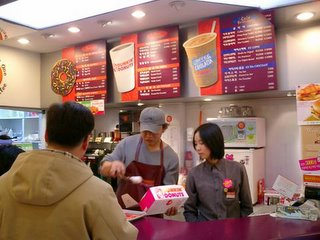
Dunkin' Donuts - Gumi Location

As anyone who knows me [or has come to know me by reading my blog] knows I love Dunkin' Donuts. This is a pic I took of the inside of the Dunkin' Donuts store in Gumi. It is beside the train station and therefore is in a very convenient location. Although I don't know his name I do know that the man working in the photo is the store manager and for whatever reason for the longest time I mistakenly believed that he was either Thai or Filipino. I still don't know why I thought this maybe just because he knew I was a foreigner he spoke Korean to me extra slowly and clearly. And, I guess that led me to believe that he wasn't a native Korean either but someone who's second language was Korean - just like me. In any case he is a wonderful guy. He is super friendly and he always makes a big deal when he sees me. It makes me feel glad to patronize his store.
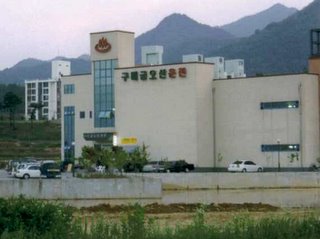
Gumi Bathhouse

This is one of the bathhouses in Gumi. It is located near the E-mart and therefore very close to my neighborhood. Truthfully, I never went there. I always meant to go but somehow I just never seemed to make it. For those of you who don't know, most apartments in Korea don't have bathtubs only a shower spout on the wall. Therefore, when you shower your whole bathroom gets wet and you have to put on plastic "shower shoes" to keep your feet (and socks dry) when you enter the bathroom. Since you can't have a nice, relaxing soak in a hot bathtub there are pubic bathhouses where you can go and pay somewhere around 5,000 won (a little over $ 5.00 Canadian) and have a bath. These bathhouses include steam rooms and tubs of not just plain water but, also, green tea, Jasmine tea, mud, mineral salts, etc. You can soak in as many different tubs as you want. All for the same price.

I have gone to other bathhouses and had I known how great they were I certainly would have gone and tried out this one in Gumi. However, at the time I didn't know and I was shy about getting naked in front of a bunch of strangers especially since I didn't know how the whole system worked (i.e. Where do I pay? Do I bring my own towel? Will people stare at me cause I am a foreigner? etc., etc.) [For the record I didn't get anyone staring at me - even though people often stare at me on the street. I've even gone to a bathhouse with an Australian friend of mine who is super tall and whenever she and I are together on the street we ALWAYS get stares but in the bathhouse no one paid much attention to us. It was a pleasant surprise.]
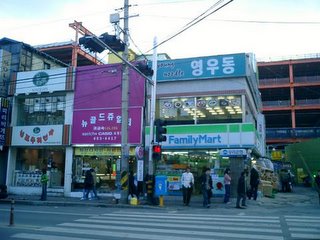
Gumi Stores


Here is a photo of some of the stores and restaurants in Gumi. They are directly to the left of the Gumi Train Station. Family Mart is a great convenience store. It even has a bank machine inside great for getting money if you are taking a trip on the train.

Gumi Train Station Under Construction

This is a photo of the Gumi Train Station when it was still under construction. I took this in March of 2004. I just wanted to show the changes that have occurred to this landmark. There is a taxi stand directly in front of the building. It was always so convenient to go there to grab a cab. Or if I didn't know the exact address of where I was going I would just tell the cab driver "Gumi Yuk [Gumi Station] and get off at the train station and walk the rest of the way where I was going.

Stairway to New Gumi Train Station

Here's the view of the stairway to the new Gumi Train Station. I took his photo at night not expecting it to turn out but it did and you can even read the sign in both Hangul and English.
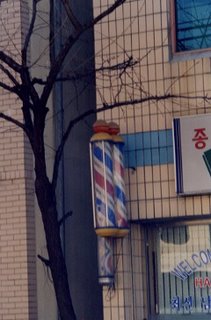
3 Poles Outside Barber Shop

I know I am going to offend people by mentioning this but I decided some time ago that I wanted to be true to both my experiences in Korea and to the true nature of Korea both good and bad. That said please understand I am not trying to be critical but to present the truth as it has presented to me. In Korea most of the barber shops have these striped poles outside of them. It makes it very easy to identify them. However, I have been told by many male friends that if the shop has more than one pole outside it then it offers "special services" to the male cliental. I do know of a fellow [a Canadian co-worker] who went to one of the barber shops for a haircut and he hadn't heard the rumors and he went to one that had more than one pole outside. He was surprised when it was a woman who cut his hair [in North America at least 90% of barbers are men]. And, he swears that he was offered a "massage" and that he could see into a backroom that was partly hidden by a curtain and that there seemed to be some "funny business" going on back there. That said I do not know any males to admit to having partaken in the "special services" so ...

Mountain Temple

One thing I like about Gumi is that no matter where you walk you get a view of mountains. Even right downtown there is a view of a mountain with a pagoda or temple on the top of it. It really is breath-taking to be able to see something so exotic [for a Canadian - anyway] no matter where I walk.

Color Pic Gumi Rice Field

Here is a picture of a rice field. What is so astonishing to me is that it is located right between the block of brick houses and apartment buildings that form my neighborhood and the E-mart store. It's not like it's located out in the country of anything. I had never even seen a rice field before and it was quite amazing for me to live right next to one.

Wednesday, February 22, 2006

Neighborhood Boys

It's hard to explain Korea to people who have never been there. It's such a homogeneous society. Coming from a multi-ethnic country like Canada it's even more difficult to imagine a country where everyone is the same race, speaks the same language, looks the same, etc., etc.

It is, also, a collective society. What I mean is that it seems to have a group mentality. North America especially is very individualistic. The history of our nations was formed by, pioneers, people who would leave the populated areas to go to a new place [like the west] and settle it. Korea is not like that. It is unusual to see anyone alone in Korean society. The children are in groups, the students walk in groups, even the housewives go to the supermarket shopping in groups. No one is ever alone.

As, a westerner I had a hard time getting used to this. And, I still never get over it when my students see me alone at a movie or alone shopping at the supermarket and they get all worried about me because I am alone. I've even had students cry and say they are sad cause I am alone. They will drag their parents over to talk to me and see if I am "OK" or get their parents to invite me home cause they think I am lonely. It's sweet that they love me and care so much about me but when I've been with people ALL day and I've only just stopped in at the supermarket to get bread or milk on the way home I want to tell them that, "It isn't a big deal" at all - at least not to me.

Anyway, since I never saw Koreans alone I was amazed when walking home from school everyday I would see this one little boy all alone. He was about 6 years old and he would be standing on the second floor of his house on the balcony everyday when I walked by. I started to feel sorry for him. The poor little boy. He was ALWAYS alone. Did he have any siblings or friends? It was so odd. This went on for weeks. Finally, one day [when my Korean had improved] I saw him standing on his balcony all alone. Then he caught sight of me and started yelling, "Wae-guk-in, [foreigner] ballie-hair-ah [hurry up]." Soon three other little boys of around the same age came running out of the door of the house and onto the balcony. They all stood there watching me walk by. This would happen everyday. As they got to know me they would try out their English on me and would call out, "Hello. How are you?" Then it dawned on me. He hadn't been alone and shunned all along. He had been the look-out. It was his duty or privilege [I'm not sure which] to watch for me [the foreigner] and call the others so that they wouldn't miss seeing me.


The Neighborhood Boys
I got to know these boys well over the months I spent in Gumi. They soon lost their shyness and everyday without fail they would run out to meet me and talk to me in English [and Korean]. It became the highlight of my day. It was quite an ego boost to think that for weeks they had kept watch for me. It was hard to imagine that just to meet and talk to me was so exciting to them - but apparently it was. They taught me a lot of Korean and after that I always felt safe in that neighborhood cause I knew I had people watching out for me or at least watching for me.

Friday, February 17, 2006

The Belfast Boys

I had the chance to meet some of the most interesting people while working in Gumi. Two of the most memorable characters were two guys from Belfast, Northern Ireland. I'll call them "Ivan" and "Al". "Al" worked at my school. He was a red-headed, soccer-player guy. "Ivan" worked at another school but he was a good friend who I dated casually. We used to hang out at PSYCHO a foreigner bar in Gumi on weekends. It was lots of fun and "Al" and "Ivan" got along great and were the best of friends.

By coincidence a couple of months later both their contracts were finished [at the same time] and they went home to Belfast for a vacation and to see their families. I kept in touch with them via e-mail and sometimes by phone. So, the first time I talked to "Al" I asked him, "So, how is 'Ivan'? Have you seen him lately?" To which he responded, "That no good protestant *%^*&... I don't associate with the likes of him here in Ireland." I was shocked and somewhat taken back not having known either of their religions - and truthfully not caring. I knew that Northern Ireland was infamous for problems between Catholics and Protestants but I had never really thought about it before and certainly not in the connection to the two of them.

Several weeks later both guys had returned from Belfast. I was in PSYCHO with "Ivan" and we were sitting around drinking draft beer [Koreans call it "Hof"] and talking when "Al" walked in and came over to our table. I was nervous not knowing what to expect. But "Al" said to "Ivan" "Hey, man let me buy you a pint." and with that they hugged each other and that was that. We spent the rest of the evening drinking together and they got along fine. They were the best of friends again.

I guess this just goes to show that when you are in Korea the rules you follow in the rest of the world just don't apply.

Wednesday, February 08, 2006

Beep, beep, honk, honk, bow, bow

Traffic In Korea:

I realize sometimes that I really am experiencing culture shock and that I don't understand the way things work here in Korea. No where is this more evident than in regards to traffic.

One of my first mornings in Gumi, I was walking to school at around 6 am I heard a lot of beeping and I thought "Wow, traffic must be bad." However, since I was walking on the sidewalk I ignored the beeping and kept on walking. I heard more beeping but didn't see anything out of the ordinary. Just then an old man grabbed my arm and pulled me out of the way as a motorcycle roared by on the sidewalk. I felt the breeze as it zoomed by and I know if he hadn't pulled me out of the way I would have been run over. I bowed to the man to thank him but he just shook his head at me as if to ask "Why are you so dumb?" I continued on my way to school and told some Korean co-workers the story. They were all calm about the incident and only seemed to be surprised that I was so indignant that a motorcycle [they call a motorcycle an "autobi"] almost ran me over on the sidewalk. I told them in Canada bicycles and motorcycles aren't allowed on the sidewalks and that they are called side WALKS not side DRIVES. But, I still don't think they understood...

Motorcycle in Market

I took this picture of a motorcycle [autobi] in the market in Waegwan. I snapped this photo just as this biker almost ran me down. I think he was surprised and a bit embarrassed I took his picture cause after I did it he bowed his head to me maybe to say, "Sorry, I almost ran you over."

I now am extra careful walking on sidewalks and in markets for I know that in Korea motor vehicles seem to have or at least take the right of way.

Korean streets are very narrow and cars and trucks park along the sides of them. This means that in most neighborhoods cars can only drive down the major streets. In my neighborhood I have to walk to the corner store and take a taxi from there as the taxi will not even try to navigate the narrow street to my apartment.

I find it interesting that if it's bad weather raining or snowing etc. which is when you want to take a taxi so you aren't exposed to the weather you still have to walk to a big street to get a taxi. This sort of defeats the purpose. Yet, if you order Korean or Chinese food it is not only delivered to your door [by motorcycle] but it is brought on real dishes making it necessary for the restaurant delivery person to come back an hour or so later and pick up the dishes. All you have to do is leave the dirty dishes at the front gate or just outside the door of your apartment. Wow! Quite a paradox, eh?

The thing I notice the most about traffic here is all the honking. Since I am partly French Canadian I was always a bit of an aggressive driver back home in Canada and I used my honk a fair amount [more than anyone I know] but in Korea EVERYONE uses their honk. I noticed that drivers honk at other cars at intersections in warning, "Don't pull out in front of me". If a car stops in the middle of a street [blocking the street in either direction] and the drivers goes into a store if a car comes and needs by the driver honks and the person in the store will run out and move the car. Honking seems to mean everything from, "Thanks", "Don't open your car door while I am driving by your vehicle", to "Get the heck out of my way" and yet in some strange way it works and makes sense to the people here. They seem to understand perfectly. I just watch in amazement!

One evening I was walking down a street and I saw a big truck parked in the middle of the street. A car pulled up behind it and honked. I stood there watching and almost laughing at the driver honking. I thought to myself, "Stupid! There's no one in the car. It ain't gonna move itself!" When all of a sudden the truck driver runs out, bows to the honker and quickly moves the truck. The honker bows his head back and drives away. I stand there in shock. Honking works! Even at an empty vehicle. WOW!!!

Narrow Streets in Korea


This is a photo of a Gumi street showing the same kind of big [bongo] truck I saw parked in the middle of the street blocking traffic in my story above. It, also, shows how narrow the streets are and how with vehicles parked along the street anyone stopping a car will completely block traffic.

Thursday, February 02, 2006

Daegu Subway Fire

I haven't posted in a few days and it is because in going back and looking over my journal I have come to one of the most heart-breaking and tragic things that happened my entire time in Korea. I am somewhat hesitant to write about it and yet I feel to be true to my experience I must. It had a huge impact on me at the time and I wrote and recorded my feelings at the time and even looking back the rawness of the feelings are still there.

I am talking about the DAEGU SUBWAY FIRE that occurred on Tuesday, February 18th, 2003.

I had been to Daegu on Saturday to get my Alien Card. I had meet people from there in the Immigration Office. I had talked to them and shared some laughs with them as we went through the process of being finger-printed. And, since I didn't go beyond that meeting level I never knew if they had been traveling to work or school and rather they found themselves becoming victims on the Subway that day. I guess I will never know for sure.

I learn about the subway fire when my Mom calls me [from Canada] on my cell phone and wakes me from the midst of a deep sleep. "Where are you?" she demands. "Why?" I ask her. "Where are you?" she repeats. "I'm in bed at home trying to sleep. Why?" I respond.

It is then that she tells me about the tragedy. I later read about it in the newspaper and hear people at school and elsewhere talking about it. It still upsets me to talk about in details so I am quoting the following two sources at length.
********************
Wikipedia has this to say about the incident:

The Daegu subway fire of February 18, 2003 killed at least 198 people and injured at least 147. An arsonist set fire to a train stopped at the Joongang-ro (or Jungang-ro) station of the Daegu Metropolitan Subway in Daegu, South Korea. The fire then spread to a second train which had entered the station from the opposite direction.
The arsonist was
Kim Dae-han, a 56 year-old unemployed former taxi driver who had suffered a stroke in November 2001 that left him partly paralyzed. Kim was dissatisfied with his medical treatment and had expressed sentiments of violence and depression; he later told police he wanted to kill himself, but to do so in a crowded place rather than alone. By most accounts, on the morning of February 18, he boarded train 1079 on Line 1 in the direction of Daegok, carrying a duffel bag which contained two green milk cartons filled with a flammable liquid, possibly paint thinner or gasoline.
As the train left Daegu Yeok station around 9:53 a.m., Kim began fumbling with the cartons and a cigarette
lighter, alarming other passengers who tried to stop him. In the struggle, one of the cartons spilled and its liquid contents caught fire as the train pulled into Joongang-ro station in downtown Daegu. Kim, his back and legs on fire, managed to escape along with many passengers on train 1079, but within two minutes the fire had spread to all six cars. The seats and flooring were composed of flammable fiberglass, carbonated vinyl, and polyethylene, and produced thick, chemical smoke as it burned.
The operator of the train, Choi Jeong-hwan, failed to notify subway officials immediately of the fire.
Errors compound the disaster

Smoke being visible on their
closed-circuit television monitors, subway officials radioed the operator of train 1080, Choi Sang-yeol, advising him to proceed with caution because there was a fire in the station. Train 1080 entered Joongang-ro station and stopped alongside blazing train 1079 approximately four minutes later. The doors opened only briefly, then shut, apparently in an effort to keep out the toxic smoke that had filled the station. Shortly after train 1080's arrival, an automatic fire detector shut down the power supply to both trains, preventing train 1080 from leaving the station.
Transcripts show Choi Sang-yeol made three announcements advising passengers in train 1080 to remain seated while he attempted to reach superiors. Finally, he was advised "Quickly, run somewhere else. Go up. . . kill the engine and go." Choi then opened the doors and fled, but in doing so he removed the master key, shutting down the onboard
batteries which powered the train doors— effectively sealing passengers inside. Later investigation showed 79 passengers remained trapped inside train 1080 and died there.
Inadequate emergency equipment also worsened the disaster. Daegu subway trains were not equipped with
fire extinguishers, and the stations lacked sprinklers and emergency lighting. Many victims became disoriented in the dark, smoke-filled underground station and died of asphyxiation looking for exits. Emergency ventilation systems also proved inadequate. Over 1,300 fire and emergency personnel responded and the fire itself was extinguished around 1:25 p.m.; however, the toxicity of the smoke prevented them from entering the station for another three and a half hours.


Victims
The intensity of the fire made it difficult to accurately assess the number of victims. Most were burned beyond recognition, many to the bone, and required
DNA analysis to identify. A total of 191 bodies were found and identified; 6 additional bodies were found but so thoroughly destroyed that they could not be identified; and 1 person's possessions were identified but remains could not be located.
As the incident occurred late in the morning
rush hour, most of the victims were students or young women who worked in the downtown district's department stores, which opened at 10:30 a.m. Many were able to contact loved ones on their mobile phones, and mobile phone operators released call connection and attempt records to help authorities determine who was in the station.


Investigation and coverup
Choi Sang-yeol could not be located for 11 hours after the accident, and investigators later discovered he had made contact with officials from the subway corporation during that time. The master key from train 1080 was found in an office at the Ansim train depot. Omissions from transcripts of radio communications also heightened suspicion of an attempted coverup.
On
February 26, 2003, authorities arrested Kim Dae-han, who had fled to a hospital for treatment. They also arrested both Chois and six officials of the Daegu Metropolitan Subway Corporation, the head of which was fired the same day.

Aftermath
The tragedy prompted outpourings of sympathy and anger from throughout
South Korea and internationally.
Officials promised to install better safety equipment in subway stations, and added spray-on fire resistant chemicals to the interiors of the cars of the Daegu Metropolitan Subway. Six stations were taken out of service for rehabilitation and restored in April
2003. The tragedy was considered by many a national embarrassment, provoking debate about whether South Korea had cut too many corners in safety during its rapid industrialization.
Also on
August 7, the Daegu District Court convicted Choi Sang-yeol, operator of train 1080, and Choi Jeong-hwan, operator of train 1079, sentencing them to prison for five and four years respectively for criminal negligence. Kim Dae-han was convicted of arson and homicide. Although prosecutors and victims' families had asked for the death penalty, the court sentenced him to life in prison on account of his remorse and mental instability. Kim died in prison on August 31, 2004 in the city of Jinju, where he had been receiving medical treatment.
**********************
CNN.com has the following photo and information about the incident.
Traditional funeral flowers line Daegu's subway entrances.
Arrests over Daegu subway disaster
Monday, February 24, 2003 Posted: 0022 GMT');
SEOUL, South Korea (Reuters) -- South Korean police say they have arrested seven railway officials over the subway fire in the city of Daegu which killed at least 133 people and has left scores missing.
"Seven people (subway officials) have been arrested and are in custody here in the Daegu Joongbu Police Station," one of the detectives in charge of investigating last Tuesday's arson attack told Reuters by telephone.
He did not specify the charges, but police said at the weekend that they were seeking charges of negligence against subway officials.
The detective said arrest warrants for the suspected arsonist and two more subway officials would be sought on Monday, because they had been hospitalized.
"Initial investigations found subway officials were negligent in their duties," a member of the investigating police team said earlier.
Relatives of the missing, some brandishing placards demanding punishment of the guilty, and civic groups marched through the rain on Saturday to the subway station in Daegu, 200 kilometers (120 miles) south of Seoul.
Most of the 300 marchers were overcome by emotion as they descended to the third level where the apparent arsonist lit a container of flammable liquid in a train, setting off an inferno which engulfed the second which pulled alongside.
Police said the suspected arsonist, identified as a 56-year-old former taxi driver with a history of mental problems, told them he had not wanted to die alone.
"I cannot find the right word to express the misery and tragedy we are suffering," Kang Dal-won, a representative of the families of the missing, told Reuters. "I want capital punishment for them," he said of those the police deemed negligent.
More than 300 people are still listed as missing after a conflagration which left some of the 12 carriages of the two trains strewn with skulls and bones.
Many of them, however, may be among the unidentified remains. Forensic experts say it may take months to determine who they are.
The investigator said the initial probe deemed three controllers negligent for allowing the second train into the station, where they knew a train was on fire.
They believed the driver of the first train was negligent in not reporting the fire properly and the driver of the second negligent for taking away the controlling masterkey without checking to see whether all the passengers had left, he said.
Domestic newspapers have suggested the train may have stood at the station for as long as 20 minutes with the doors closed and the majority of the dead are thought to have been aboard it.
The latest tragedy in a country with one of the worst traffic and public works safety records in the industrialized world shocked President-elect Roh Moo-hyun, who takes office on Tuesday in ceremonies scaled down to reflect public anguish.
"I feel shame and strong responsibility that those in charge of safety at public facilities worked with such a poor sense of safety awareness," he said on Friday. "We should feel like we committed a sin against the people."
Saturday's marchers also demanded that the subway station go unrepaired until the investigation was completed.
"The cause of the accident will disappear if the city rushes to repair the station," said Kim Hye-jung, another representative of the families of the missing.

Confusion

Trains are running, but many are not ready to travel on the line again.
Chief investigator Cho Doo-won said on Friday the driver of the second train told investigators he had ordered passengers over the loudspeakers to get out three times and waited 10 minutes before removing the masterkey and leaving himself.
"We are focusing our investigation on the possibility that he left the train at a timeframe that was not 10 minutes," Cho said.
"After he escaped, he said he had given his jacket to a co-worker. We discovered that the masterkey was inside that jacket." Asked why the driver had handed over his jacket, Cho said: "He did not provide the reasons for that."
One survivor from the second train, sitting in the second or third carriage from which he could not see the fire on the first train, said the doors did open initially.
"We arrived at the station, the doors opened and smoke billowed in. Then the doors closed again," Lee Chang-ho, a 27-year-old student, told Reuters from his hospital bed.
"The driver told the passengers twice through the loudspeakers that the train would leave soon."
Lee said he thought it was about 10 minutes before passengers were finally told to get out. Lee said he had groped his way up the stairs through smoke so thick he could see nothing, tripping many times over what felt like bodies.
"What hurts me most is if they had told us to evacuate earlier, fewer people would have died," he said.
The link to the CNN site that tells more about this is here
CNN.com RE: Daegu Subway Fire
******************
Several weeks later a Korean friend took me to Daegu for the day to go sight-seeing and while we where there he asked me if I wanted to see the site of the subway fire. I was hesitant but I knew that ignoring it wouldn't make it any less real. I remember the family members of the people who died living in the subway. It was black with soot and they were sitting on blankets on the floor holding vigil. There were pictures of the dead and even food laid out for them. Some of the victims were quite young so some of their favorite food was strawberry milk and moon pie. I looked at the pictures of the people who had had their lives cut short and I especially remember one who was a girl in her early twenties from Gumi and she was training to be a police officer.
What I remember the most is that on the soot covered walls that had previously been white tile people had written the names of their deceased loved ones and messages to them like "I love you" and "I miss you." It had quite an impact on me. And, it made my family in Canada more nervous about me continuing to live and teach in South Korea. But I reminded them that tragedy can happen anywhere and time.

Wednesday, February 01, 2006

Gumi Municipal Library

I decide to explore my city more so I go off to the city library in Gumi. In Korean it's called "She Rip Do So Gwan" which means Municipal Library. Unfortunately, I didn't bring my new Alien Card so I can fill out the form to get a library card but I can't complete the process until I come back with my Alien Card. I am allowed to use the library but I can't borrow any books.


This is a picture of the Municipal Library in Gumi. For more information on the library go to the following website. It's in Korean but it has a great streaming video of the library.
Gumi Municipal Library

Since Gumi is a growing city many places have changed since I first visited them in the Spring of 2003. The same is true for the library which is obvious if you look at the difference between this picture and the streaming video on the link.


I decide it's about time to start learning some Korea so I look at the children's books. Being the only Westerner at the library I attract a lot of attention! Mothers keep pushing their little kids to come over and say "hello" and practice their English on me. This is fine for about 20 minutes and then it I start to feel a little like a trained bear in the circus. So, I decide to turn the tables and I find a picture book in Korea and I make the kids teach me Korea. I will help them with English but only if they tell me the words in Korean. I learned a lot of baby words. It's sort of humiliating to realize that I don't have the vocabulary of the average Korean 2 year old. But I guess I got to start somewhere. In fact, the kids seem to think its more fun to teach me Korean than to learn English. So, I guess I am getting the better part of the deal.

It does make me consider that maybe I should think about coming back and doing a story time with some easy English books. I bet it would be fun and a great way to meet more people and maybe even learn some more Korean.

The librarians are very nice to me and not only help me fill out the paper work [which is in Korean] so I can get a library card but when they discover I don't have my Alien Card with me they agree to put my application aside and just hold it until I come back another day. This saves me having to fill out the papers all over again. It seems like a hassle to me but when I look at the section of English books there are at least half a dozen good novels there that I have never read like "The Poisonwood Bible" so I decide it's worth the effort. There are only about 50 English books in total but the librarian tells me they will get more for me. In turn I tell them I have some books at my apartment I have read that I will bring and donate to them - if they want. They seem very surprised and excited that I would consider adding to their collection of books that way. Maybe it's not such a common thing to do in Korea with all the reading rooms where you pay to read comic books. In Korea I discovered that there are a lot of stores where Koreans rent comics or other books just like we rent videos and DVDs in the West.

I get busy and don't get back to the library for several weeks but when I go back I not only bring my Alien Card but I have at least 20 English novels to donate [when the other English teachers at my school heard about my adventure at the library they all started collecting their English books for me to donate for them, also]. The same librarian I talked to before is working. She takes me over to see that the library moved some books around made room for more English books and that they even bought 2 new English novels. It makes me feel bad that I kept procrastinating and took several weeks to get back. They were obviously waiting for me.

I show them my Alien Card and they record the number for their records and even photocopy it for their files and issue me my own library card. Having accomplished this I really feel like I am starting to settle in and make Korea my home.

Above is my scanned Gumi Municipal Library Card [I photo-shopped out my personal info but other than that it's legit]. I still have it. Some day I plan to go back and visit the new library.

About two weeks later I get a letter in Korean so I take it to my school to get someone to translate it for me. It is a letter of thank you from the library for donating books. Donating books was such a small thing for me to have done but it obviously was appreciated. It leaves me feeling warm and fuzzy. It makes me feel confident and excited about exploring even more places in Korea.

Tuesday, January 31, 2006

Getting An Alien Card in Korea

Getting an Alien Card in Korea:
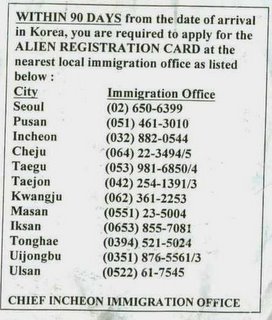
This is a necessary procedure for any foreigner wishing to live and work in Korea legally. Also, it must be applied for at the nearest Immigration Office within 90 days of your arrival in Korea - if you arrive with a working Visa. In my case I had an E-2 [Conversational English Teacher] Visa. So, within 90 days of my arrival I had to go to Daegu [South Korea] about a 30 minute drive from Gumi [South Korea] to register at Immigration. In fact, when I got my Visa in Toronto, they paper clipped the following paper into my passport.


Phone Number of Immigration Offices in Korea

[Author's Note: On this paper Daegu is spelled Taegu. There is some confusion in Korea about the Romanization of Korean and therefore often D and T are interchanged as are B and P. Lastly, G and K can be used interchangable in place names. This leads to a lot of confusion cause some people say they live in KUMI and some people say they live in GUMI. It's the same place just spelled differently. Having gotten used to this I am try to be consistent about spelling place names I always spell Gumi with a G and Daegu with a D. However, I am not consistent is the spelling of Busan/Pusan. Sometimes I spell it will a B and sometimes I spell it with a P. Just want to you know it's the same place.]

***********************************

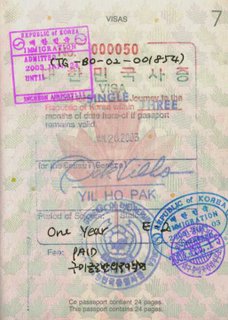
Below is my E-2 Visa. They have since changed it and made it a computerized paper that is pasted into your passport but this is what it looked like in January 2003 when I got it in Toronto, Ontario, Canada.E-2 Visa January 2003

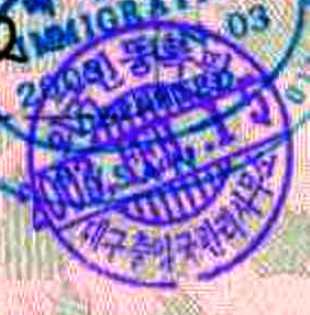
Alien Card Stamp on E-2 Visa

I know it's a little blurry and hard to read but above is a stamp on my E-2 [Conversational English Teacher Visa]. It says that the Daegu Immigration Bureau issued me a Wae-guk-in [Alien or direct translation is "foreigner"] card on February 15, 2003.

It's important to get an Alien Card for without it you usually can't do even the most necessary things like:

  1. Open a bank account
  2. Buy or set up cell phone service - not even Pre-paid or "Pay as you go" cell phone service
  3. Get internet hooked up
  4. Register at a hospital or clinic - this is not to say you can't get medical treatment cause you can but they always ask for your Alien [Wae-guk-in which actually means "Foreigner"] Card.

So, on Saturday, February 15th, 2003 Mr. Kim picked me up at my apartment and drove me to Daegu to get my Alien Card. I remember being excited to get this process over but unfortunately I didn't record about it in my diary so in writing about it I am relying on my memory. I know that I had to take my passport and my University Degree - the original degree - and I think Mr. Kim had some papers with him from the school like the school's business licence or at least the number of their business licence.

What I will never forget is that I was finger-printed. I didn't expect it. I had NEVER been finger-printed before in my life. And, all of a sudden I was being finger-printed! I was horrified! I felt like a criminal. Luckily, there were some other foreigners there going through the same process and so I was able to laugh and talk to them about it.


The worse part of the whole finger-printing process was afterward in when I was sent to the bathroom to try and wash up. There was no soap or paper towel in the bathroom and the water was ice cold. Trying to get the black ink off of my fingertips with icy cold water and no soap was useless!

I later learned that all Korean people get an ID card and that they are finger-printed for it. They even have a scanned thumb print on the back of their ID card. So, it being finger-printed was not some kind of a discrimination thing or some comment of the likelihood of my committing a future crime. It was just a standard procedure.

***********************************

There are some websites that tell more about getting an Alien Card in Korea. One of the best is at Dave's ESL Cafe. Here is the link. Unfortunately the download applications do not work and I was not able to find another place to find them but it does offer information and tells how the first time you go you will be fingerprinted [wish I had known that, ha, ha] and to take at least 3 small passport sized photos. I think I only had 2 one for the card and one for their files but maybe you need 3 now [better safe than sorry].

Alien Card Info

Another website I found with all kinds of useful information about Korea is LifeinKorea. I have the link for it here.
Life In Korea

One of the best blogs I've read about Life in Korea is I Have Seoul. This is another Canadian English Teacher in Korea. Shaun has tons of useful links and information. His information is for Canadian and the map is for Seoul. To find the office nearest you ask someone at your school or call the numbers of the offices I have listed above. Someone in every office speaks some English. Or at least I have always found that to be the case.
Here's the link. I Have Seoul

I found a website with information of how to get the Daegu/Taegu Immigration Office. Here's the link. Daegu Specific Information


Sample of Alien Registration Card


Above is a sample of what an Alien Registration Card looks like. I found it on a Korean Government website. So they don't get me for copyright violation here's the website I copy this image from. City of Daegu

I hope quoting my source is enough to mean I am not infringing on a copyright. I would have scanned in my Alien Card and blurred the personal info. but I have never had a scanner in Korea and I never took my Alien Card out of the country so I don't have any copies of it.

******************************

So I get my Alien Registration Card [ARC]. Having gotten this process out of the way I feel more established in Korea. Now I can open a bank account. Yippee!

Monday, January 30, 2006

Long Days Get Longer in Gumi, Korea

My days in Gumi, South Korea were long and before the day was over they were to get a lot longer. It all started when a girl from my school who I'll call "Maureen" got a job offer from a university here in Korea. It is the same or better pay and at least 2 months of vacation time vs. the 10 days we get from our school. She somehow negotiated with the school to release her from her contract. So we have a going away party for her. I am happy for her but sad that she is leaving. Gumi just won't be the same without her. She is sort of an inspiration to me as she is from a small town in Eastern Canada and yet she has a Korean Driver's Licence and having bought a cheap car and she drives everywhere. She is fearless!

Right now my schedule sucks and it's about to get worse. My timetable goes like this:
  • Leave my apartment at 6:00 a.m. to walk to the school.
  • I teach a 6:20 a.m. class at the school.
  • At 7:10 a.m. one of my student's picks me up at the school and drives me to LG TV where I teach from 7:30 a.m. [or whatever time we get there - sometimes it's later if traffic is bad] until 8:20 a.m.
  • At 8:30 a.m. Mr. Kim [if he shows up - If Mr. Kim doesn't show up then I either get a drive with Jin Teacher or take a taxi] picks me up and drives me to LG Learning Center.
  • At 9:00 am I start teaching at LG Learning Center and teach until noon.
  • Then I have a lunch break but I am required to eat with my students in the cafeteria. They [wanting free time as much as I do] don't dawdle over lunch so usually they have finished eating at 12:15 or 12:20.
  • After eating until 1:00 p.m. I am free to do what I want like go for a walk or check my e-mail on one of the many free computers.
  • At 1:00 p.m. I start and teach again until 4:00 p.m.
  • At 4:00 p.m. there are staff meetings and forms and papers to fill out.
  • Then I get a drive back to the school in the school van and walk home to my apartment and my day is over.
  • So I am usually home by 5:30 p.m. at the latest.

It makes for a long day but it's do-able and I love the students I teach especially the students at LG Learning Center.

Now, however, since "Maureen" is leaving they need to get someone to teach her 5:00 p.m. class at LG-Phillips. So on Monday, February 10th, 2003 I am informed at 4:20 p.m. as I am about to head out to the school van for my drive home that "Maureen" will be picking me up in her car and taking me to LG-Phillips where she will introduce me as the new teacher. "Julie" the manager of our school comes with us and I think it is to make sure that the company likes me and has no concerns with me taking over as their teacher. Soon, however, it becomes clear that although the school is letting "Maureen" go to take a better job they have no intention of telling the students this. "Julie" tells "Maureen" in the car to tell the students that someone in her family - like her mother - is ill and that she has to go home to be with her. "Maureen" doesn't want to lie but "Julie" tells her if she doesn't they won't release her from her contract and that she will then not be able to take the new job nor will she will be unable to work in Korea until her Visa expires. They argue over this in the car and eventually they decide that "Julie" will lie to the students about the "illness of a family member" and that all "Maureen" has to do is agree if asked about it or minimally - JUST KEEP HER MOUTH SHUT.

Well that's what happens. The students like me cause I can speak a little Korean and cause I joke around with them and so they don't ask too many questions. "Julie" and "Maureen" leave before anyone can think of any questions to ask about "Maureen's" mom and I am left to try and teach a class for which I have no book for and for which I had zero time to prepare. Boy those ice-breaker games I have in my repertoire from teaching Life Guarding back home sure came in handy.

In a way I am happy cause now I will be getting overtime pay as I will be teaching so many more hours than are in my contract. Moreover, I am happy for "Maureen" as she had become sort of my role-model. I look at her doing things like driving around in Korea in her own car or getting a job teaching at a university and I say to myself "Hey, I could do that, too."

But now my long day is even longer stretching out for more than 12 hours and 90 % of that is either teaching or lesson planning or filling out some kind of paperwork for the school. Now I will leave my apartment before dawn and get back after dark. I wonder if everyone teaching in Korea is working such long hours?

***********************

But I am reminded of the yin and the yang [normally shown in black and while but in Korea it is pictured in red and blue on Tae-guk-i or the Korean flag] that represents the balance in life. According to information I have read "the circle in the center, red upper half and blue lower half, represents absolute, or the essential unity of all being. The Yang (positive) and the Yin (negative) divisions within the circle represent duality. Examples of duality are heaven and hell, fire and water, life and death, good and evil, or night and day".

Korean Flag - The Tae-guk-i

I found a link that explains more about this.

Korean Flag

I guess the positive and the negative, as almost everything in life, sort of balance out. I am able to find some more positives from having to teach this new extra class. Well, true to the title of my web blog, I am a little guy crazy. And, my new class has some cute young guys in it. Below are photos of two of my new students.

Nuke - My Student

[Nuke, Daegu Train station, Daegu, South Korea, February 2oo3]

This is Nuke. He is so cool. He spent somewhere between 6 months and a year in Vancouver, Canada and as a result he loves Canada and Canadians. Even in this picture he is wearing sports clothing with the Canadian flag. His English is excellent and he gives me his e-mail and cell phone number and declares himself to be my official interpreter. I am so fortunate to have met him!

Rok - My Student

[Rok, Gumi, South Korea, February 2003]

This is a picture of my student Rok. He is a little more conservative than Nuke and more worried about his ability to speak English but once we get joking around he forgets to be nervous and his English really flows. He has a great sense of humor and I must admit I do have sort of a crush on him. Wonder where he is now......

Sunday, January 29, 2006

I Love E-Mart

During my time in Gumi, South Korea I came to love E-Mart. It is a huge department store much like Wal-Mart. It is the Korean version of Wal-Mart. It is where I first went grocery shopping. But as I explored I found it had a lot more to offer than just a good supermarket in the basement.

Food Court at E-Mart
I found a food court on the first floor. It had Chinese, Korean and Western food. It even had a McDonalds. I ate McDonalds for lunch and took this picture. I am amazed at the baby carriers they use in Korea. They are some sort of a quilted blanket with straps. It is wonderful in that I've seen mother's use it as a blanket to cover their child when they take them off their back.
[E-Mart Food Court, Gumi, South Korea, February 2003]

Funky Hairdrier

I found a Hair Salon on the third floor of the E-Mart. It had the coolest looking hairdryers I've ever seen. Or at least I think they are hairdryers. I can't imagine what else they could be. [E-Mart, Gumi, South Korea, February 2003]

Old-Fashioned Perm Machine

I had seen this type of perm machine in a Hairdressing School window used as a display years ago in Halifax, Nova Scotia but I had never seen one used in real life. I took this picture and tried to stay and watch for a few minutes to see the procedure but as the only foreigner in the E-Mart I was attracting too much attention so I had to quickly move on. [E-Mart, Gumi, South Korea, February 2003]

Flowered Toilet Seat

I hope I don't seem obsessed with bathrooms and toilets but with my problems using squat toilets and having to always remember to bring my own toilet tissue I was so amazed and pleased to see these beautiful toilets with dried flowers imbedded in the plastic of the seat. The bathrooms at E-Mart are clean and bright with western style toilets and plenty of free tissue. A few years ago when I first arrived in Korea a friend showed me a web blog written by a teacher in Seoul and the whole premise of her blog was a bet between her and her friends on rather she could spend a whole year in Korea without ever having to use a squat toilet. Every week she would update her blog. When I read it she was about 6 months into her stay in Korea and she yet had to use a squat toilet. I wish I had written down the web address I would love to see if she actually won the bet. It was most amusing and hopefully it helps illustrates my point of how important something like a bathroom can become when you are experiencing culture shock and NOTHING is like home. [E-Mart, Gumi, South Korea, February 2003]

Squid For Sale

A visit to E-Mart is not complete without going to the supermarket to check out the interesting food and to buy some groceries for home. I saw this it looks like squid. I might actually have tried it if I could have figured out how to cook it. [E-Mart, Gumi, South Korea, February 2003]


Some Kind Of Bacon
This appears to be bacon. I buy a package of it and some eggs and take it home to make a Sunday brunch. It was excellent. The stone statutes are traditional in Korea. They are usually very big and outside. I have been told they are especially popular on Jeju Island. I think they are called Har-a-bong. I believe that is the Jeju dialect for Har-a-budge-i which in English is "Grandfather". [E-Mart, Gumi, South Korea, February 2003]

*********************************************************

So with clothing, hairdressing shops, a food court, a supermarket, and clean bright washrooms E-Mart has something for everyone. I always found almost everything I needed there.

Saturday, January 28, 2006

Saturday Workshop - 3 Life Lessons

Saturday, February 8th, 2003


Well, it's my third Saturday in Korea and I have started to settle in. When I signed a contact back in Canada to come and work for this school I agreed to the fact that there would be 4 Saturday workshops throughout the year that are mandatory. I hadn't realized at the time how tired I would be and how much I would be looking forward to my weekends for "down time". I am required to be at the school at 8:15 a.m.

I arrived at about 8:10 a.m. only to find out that not everyone had arrived and it was a case of "hurry up and wait". So, I grabbed a cup of coffee from the vending machine and sat down to wait. Our supervisor who I'll call "Julie" is running around trying to get us organized. The first problem is that for the Korean, Japanese and Chinese Teachers it is a weekend workshop and they are required to spend the night at the camp and attend the workshop tomorrow, too. The "Native Speakers" were told the workshop was only on the Saturday and that is what is in our contracts. A huge debate results with the other teachers resenting the Western Teachers. I am so new I just sit there drinking my coffee and trying to stay below the radar. Eventually, it is decided that the Westerners only have to attend for the day. And, we all climb into the vans and drive 30 minutes to the location the workshop will be held at somewhere near Waegwan towards Daegu of Gumi.

The day drags on and on and ALL of the meetings are in Korean and nothing is translated into English. The English Teachers start to get restless [me included] why are me required to be here? We can't understand anything of what is going on and we sure can't contribute. Then we break for lunch and Tony is given a digital camera and told to take pictures of us. I hear one of the other English Teachers mumble that this is why we are here. It's all a "photo opportunity" to promote the school. I think that is very cynical but as the day drags on and I learn absolutely nothing and understand even less of what is going on I begin to concur.

After supper [the evening meal at around 6:00 p.m.] "Jamie" our recruiter showed up. All the Canadian English Teachers have the same recruiter. He had told me he would be coming to Korea to visit the school within my first couple of weeks. My starting at the school just happened to coincide with his annual visit to the school. I had never met "Jamie" before. I had talked to him on the phone a lot in Canada prior to coming and he was the recruiter my friend "Mary" had used.

It was really nice to meet him. Even more so since he brought sheets from Canada [my Mom - at my request - had shipped some to him for him to bring me]. After 3 weeks in Korea I finally have the bedding I want and need. Yippee! Moreover, he is able to get me an advance of about 150,000 won [or a bit over $ 150.00 CDN] on my salary. I didn't have a lot of money when I left Canada and I was worried when I learned I would only be paid once a month. I wondered how I would survive for over a month with only $ 200.00 CDN. But, "Jamie" had reassured me and told me he himself had been in a similar situation when he first went to Korea to teach and so had many of the other teachers he had recruited. He had told me it wouldn't be a problem to get an advance. However, although I had tried several times I had been unable to get an advance. But when he showed up and I told him my problem and within 5 minutes I had cash in my hand. It was amazing how he made things happen.

The other English Teachers seemed glad to see him, too. However, some of them just wanted to give him a piece of their mind cause they are not pleased with the disorganization at the school.

Then a new crisis arose. It became apparent that the "Native Speakers" were expected to spend the entire weekend at the workshop. When "Julie" had told us just that morning that we could go home that evening she had neglected to tell or clear this with our boss [Mr. X - the owner of the school]. Moreover, we learned that there had been no preparation made to get us back home. No one had been scheduled to drive us the 30 minutes back to Gumi. Had this been made clear to us the day before or even that morning we could have prepared and packed some clean clothes, snacks, etc. But we weren't prepared to spend the night. We didn't even have our toothbrushes. Added to that fact was that not only were there no beds there weren't even separate rooms for the male and female teachers. The Korean Teachers got some blankets and start to spread them on the floor of the room next door to the conference room. Some of the more senior Canadian teachers start to freak out. They didn't want to stay under these conditions and especially not after being told we could go home that evening.

To this day I'm not sure what would have happened if "Jamie" hadn't been there but luckily he was. Sensing a revolt he took the boss aside and showing him his Korean Driver's Licence he asked if he could borrow one of the vans and drive us back to Gumi. Eventually, our boss agreed if somewhat reluctantly.

"Jamie" became a hero to the Canadian English Teachers and I learned a couple of valuable lessons:

  1. No doesn't always mean "NO". It might merely mean you need to get someone with more influence to ask for what you want/need on your behalf. I had been told I couldn't have an advance but "Jamie" was able to get one for me in a matter of minutes.
  2. There is usually a reason for things even if it isn't logical to you. It might be that your presence is required for photographic or publicity purposes. For example, the cynical comment of one of my fellow English Teachers proved true. The "Native Speakers" were needed at the Saturday Workshop so we could have our photos taken. I know this is at least partly true because I later saw the photos that Tony was told to take on the school's website.
  3. Korean people [and actually most people in general] don't like to lose face and therefore they don't always handle conflict directly. As a result don't believe everything you're told [either by a boss or a recruiter]. When we got upset and were causing a delay debating about having to spend the weekend at the workshop "Julie" simply took the path of least resistance and told us what we wanted to hear - namely that we only had to attend the workshop for the day and could go home that night.

*******************************************************

I know this might seem like I am being very negative and harsh and perhaps I am at least in this instance. But, remembering these three points have always stood me in good stead in Korea and elsewhere. If I "expect the worst but hope for the best" than I am not so frustrated and disappointed when things don't go as I planned or was promised. And, often I am pleasantly surprised. Not such a bad lesson to learn in life.

Friday, January 27, 2006

My First Week Of Teaching In Korea

Friday, February 7, 2003

This post is about my first week of teaching in Korea. Well, week one is over and it actually went pretty well. I am surprised and pleased! I met some great people. I took some pictures of my favorite students, as well as, some of the Korean teachers I work with. I have been teaching only at TV and at LG Learning Center.

LG Learning Center is so posh! It is set up like a dorm for the students to live in for six weeks while they take English Immersion. There is a cafeteria there and a small convenience store. There is a gym and lots of lounges. There are even free computers that aren't password protected that I can use. My student Bill even showed me a place I can re-charge my cell phone battery for free. [My school finally gave me a cell phone to use. They own it but I pay the bill for the airtime usage. I guess they got tired of never being able to get a hold of me]. I love working here. It is so clean and modern and comfortable. There are coffee machines but they are free. You just push what you want. It's a whole other world from the school. I love it - it's amazing!

So far teaching in Korea as been a lot easier than I expected. The English level of the students is much higher than I expected or hoped. I had thought that I might be doing a whole lot of drawing pictures on the blackboard or using a lot of motions and body language to get my point across and I hadn't had to do much of that. I realize that maybe teaching Executives for a company like LG means that I am teaching students who are a higher caliber or who have had more English lessons. But whatever the reason I am just thankful.

I was impressed with my Level 2 - Intermediate students today cause when I went into the classroom there was a whole pile of candy on my desk. But then they admitted that they just took it from one of the free candy dishes in the lounge. Oh, well it's the thought that counts - I guess.

Bill

This is my student Bill. He chose his nickname because he says he "loves money". He is so funny he always makes me laugh. It is he who finally helps me choose a Korean nickname. Everyday he comes to class he says to me, "Ann Teacher. In Korea man is sky and woman is ground." And, I always reply to him, "Bill Student. In Korea teacher is honored so teacher is sky and student is ground." Finally one day he tells me he has the "perfect Korean nickname" for me - Sky. [Ha-nul]. He tells me I am his "Sky". I then go out and buy a stamp with my Korean nickname on it. And, to this day I am Ha-nul [Sky].


My SKY Stamp

This is my Ha-nul [Sky] Stamp. I love it.

Sam
This is my student Sam. He is in Level 1. He is a character. He always keeps us laughing.

Sunny Teacher
This is Sunny Teacher. She is in charge of all of us Teachers at LG Learning Center. She is very organized and dedicated. She keeps us on track.

Jin Teacher
This is a picture of Jin Teacher. She and I are becoming good friends since we teach at the same LG factory and travel together from there to LG Learning Center everyday. We weren't supposed to. She has a car and drives herself but she saw me waiting outside day after day at factory waiting for Mr. Kim to come pick me up and then he would never show up or show up late so I'd get in trouble with Sunny for being late arriving at LG Learning Center. So Jin volunteered to drive me. She is just so thoughtful that way.


Level 1 & Level 2 and Me

This is a photo of me with some of my Level 1 and Level 2 students also included are Sunny Teacher and Jin Teacher.

Level 2 and Me

This is me and my favorite class. My Level 2 class. I know I am not "supposed" to have favorites but I think it is only natural for every teacher to have a favorite student or class and since I haven't taught them in more than 2 years I think it's safe to admit my biases now.


*************************************************
The only sad part of my week is that "Nora" and "Amber" who are the other two Native Speakers teaching at LG Learning Center have moved into the building and away from their apartment for the next 6 weeks. This is because they have no other classes and the students are wanting someone to help them with homework in the evenings. I can't say as I blame them the facilities are lovely and they get free food and an on-site gym and computers to use, etc. But it means that I am back to being alone in my Korean neighborhood with only my Chinese roommate and using my Korean/English Dictionary to try and converse.

Wednesday, January 25, 2006

Mistakes & Confusion in Korea

Thursday, February 7th, 2003

My first week or two in Korea were marked by misunderstanding, confusion and mistakes on my part. I guess that's just natural when you move half-way around the world. And, although I am amazed at how well I am able to survive and adjust to live here in Korea it doesn't always keep me from making some very big and sometimes very awkward mistakes. Three of the most memorable are as follows:

  • One of my first mornings in Gumi I was awaken to hear a loudspeaker blaring something. [Prior to coming to South Korea ALL I had heard on the news and from my family back home in Canada was that is isn't safe to go to South Korea cause North Korea has nuclear weapons and can/will invade at any moment. I reassured my friends and family that is was safe or Canada would not allow me to go and that there weren't even any travel advisories against South Korea]. I guess I was more nervous about the potential of North Korea invading South Korea than I had admitted to anyone including myself. For, in my half asleep state I thought the loudspeaker was announcing an evacuation or air raid or some such dire thing. It was only around 6:00 a.m. so I hurried out of bed and got dressed and was hurrying to stuff my passport and traveler’s cheques into a backpack when Ms. Park, my Chinese roommate saw me and started laughing at me. She lead me to the fridge and showed me some lemon melons and with sign language and a dictionary and pointing out a window to a blue bongo truck FINALLY made me understand that the loudspeaker was just the advertisement for the melons for sale. I didn't know rather to be relieved that I was safe or to be annoyed that I had been woken from a sound sleep and scared to death by some stupid truck trying to sell produce.


Bongo Truck Selling Fruit

  • The second mistake I made happened because I know that it isn't safe to drink the water straight from the tap [in Korea] and getting tired of drinking tea and coffee I decided to buy some bottled water. I went for a walk one night and stopped at a small convenience store [not the normal corner store I usually went to]. I found a large 2 liter bottle of water and the price was really good like about $1.50 Canadian. I said to the Harmonie [Grandmother] running the shop mul [water?] when I took it to the counter to buy it. She smiled at me and nodded. I bought it and took it home. I needed to take a vitamin pill so I just took the cover off and not bothering to get a glass I put the vitamin tablet in my mouth and proceeded to take a large mouthful of water to wash it down. Well as soon as the liquid hit the back of my throat my eyes teared up and I spit the fiery alcohol all over the place. The vitamin pill went flying and hit the wall. I was coughing and chocking when Ms. Park came in and started patting me on the back. She laughed at me and told me something in Korean I couldn't understand. Finally, she mimicked a drunk person staggering around. She told a co-worker who spoke some English at our school the next day and I was informed I had tried to drink Soju for water. Of this one fact I became convinced SOJU IS NOT WATER!

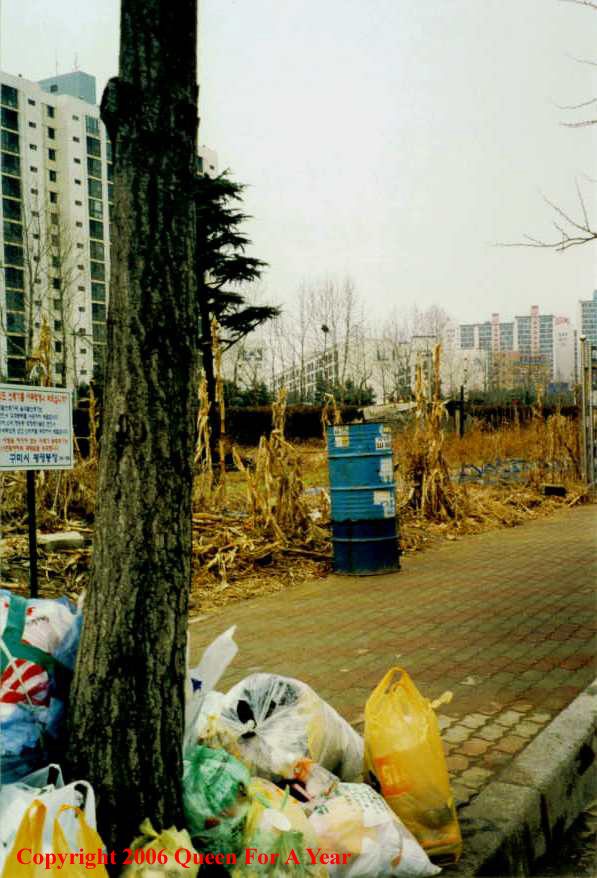
  • The third and final mistake I made in my first week living in Korea was because of my ignorance of the culture and how things worked. When the teacher I was replacing left she had left a lot of stuff [some of it was useful to me and I was glad to have it] but in sorting through it I found a lot of old papers, empty juice and beer bottles, and just plain garbage. So, after sorting the recyclables I bagged them up to take them out. There must have been at least 6 bags of recyclables and 7 or 8 bags of garbage. Only about a block from my apartment the day before when I was walking to school I had seen neighbors putting trash out near a tree by the road. So everyday when I left the apartment I could grab a bag or two and take it. The second morning I did this my landlady [who lived downstairs] came running out after me yelling "sur-reg-ei" [garbage]. I couldn't figure out what she meant. Was she calling me garbage? Did she want me to take out her garbage, too? What was going on? Since I couldn't see any other spot for garbage around the neighborhood I ignored her and continued to take out the garbage and recyclables each day until they were gone. But everyday she would chase after me yelling "sur-reg-ei". Eventually, I remembered to ask an Administrator at the school what she could mean. And, I found out that in Korea it is OK to put out recyclables in old grocery [in my case E-Mart] bags but that for garbage one had to go to a convenience or corner store and buy a "special" garbage bag. Since there is no city tax to cover dump fees so you pay each time you buy a gargage bag. Sure enough I went to the corner store and asked for a "sur-reg-ei bong-tu" and paid 1,200 won [over $ 1.20 CDN] for one large bag. The next time I took out the garbage my landlady came out saw the bag smiled at me and patted me on the back and went back in her house. Poor thing she had just been trying to tell me I was making a mistake and doing the wrong thing. I've heard that the fine can be upwards of $1,000.00 CDN so she was trying to save me. I just didn't know it.


Gumi Garbage Spot

Tuesday, January 24, 2006

Grocery Shopping In Korea

Tuesday, February 4, 2003

I am about to go grocery shopping in Korea for the first time. I am excited and more than a little nervous. I don't know what to expect or how I will make out since I don't speak the language. But since I've finally gotten to a bank and managed to cash some Traveller's Cheques and changed the money into Korean Won nothing is stopping me from going shopping except my own apprehension. Yippee! This means I can finally go shopping. So far I've been in Korea over a week and so far I've lived on just orange juice, bread and peanut butter.

The other Westerners have told me that the best place for foreigners to buy groceries in Korea is to go to large department store. Fortunately, our city, Gumi, has an E-Mart department store. It is sort of like Wal Mart only it's Korean and it has a grocery store in the basement. I go up to the roof of my apartment to look around and get my bearings. I can see the huge E-Mart sign and get the basic direction in my head. So off I go. Other than just going to the local corner store this is will the first time I have gone to either a department or grocery store in Korea. I am excited but a little nervous. I wonder what it will be like.


E-Mart Sign
This is the huge E-Mart sign I can see from the roof of my apartment. It is like a beacon calling me.Diver Mannequin

There is a mannequin dressed as a diver in the fish section of the local E-Mart. I bump into it and apologize before I realize it is only a display. I notice several Koreans looking at me and laughing. I guess it's not everyday they see a goofy foreigner that not only apologizes for bumping into people but inanimate objects. (Did I mention that in Korea there are so many people that bumping into someone is inevitable so people don't apologize to one anther.)

Fish Section
This is the fish section of E-Mart. I love all types of seafood and the fish is relatively cheap so I am happy to have found this counter. The man who works there is shouting out something in Korean. I decide it must be something like, "Buy my fish. It's really fresh."

Some Kind Of ShellfishHere is some kind of shellfish that's for sale. I like this picture cause it shows the Hangul [Korean characters] on the sign. I want to buy this and try it but I am unsure how long I would have to boil it and then how I would go about digging it out of the shell to eat later. And, unfortunately there is no one who speaks enough English for me to ask.

Aloe Stalks For Sale

I want to buy a plant to make my room and apartment more homey and I had an aloe vera plant back home so I want to buy one here but I can't find one. I think maybe they don't have them in Korea and then I see this HUGE aloe stalks for sale in the supermarket. It makes me more determined than ever to find a small one for my apartment. They have a drink made with chunks of aloe vera in it and it is worderfullly refreshing and tasty.

Mushrooms

These are mushrooms. The Koreans call them Pangie (it means a spinning toy top in Korean and they are called this because the heads look like the rounded stick the toy top spins on). I saw "Nora" making an omelet at her apartment and I didn't know what they were. She told me they are mushrooms and that they taste the same as the Portobello mushrooms we use back home and are a lot less expensive. You can get 5 bunches of them for around 1,000 won or a little over $ 1.00 CDN.

Octopus For SaleI see packages of this octopus for sale at the supermarket. I love fish and shellfish but this is taking it a bit too far even for me. I can't imagine how it is cooked and prepared and then I remember calamari [squid] and suddenly it doesn't seem so far fetched.

**************************************************************

I am excited by all the food to be found. A lot of it is unfamiliar but there is Western food, too. I find yogurt and pasta and cans of Campbell's soup and even some prepared pasta and potato salad in the deli section. This is a great relief to me cause although I thought I liked spicey food and I do if it's Mexican, Thai food or even Indian curry. However I have come to realize in the last week that I don't like red pepper paste. And, I am realizing that this is going to be a big problem here in Korea. Maybe I will have to learn to cook. I never did much more than make toast or heat up soup back home but I have a feeling that this is about to change.

P.s. I figured out that when you buy food in Korea by also have to buy the plastic bag. They ask you something at the cash register that I couldn't understand or make sense of it until the clerk held up a plastic bag and said, "1 or 2?" So I said two and was charged about 10 won - about 4 cents in CDN money and I proceeded to pack my groceries and leave the store.

My successful shopping adventure is over and I feel good. I am finding my way around Korea [my new home] and so far I am surviving.

Saturday, January 21, 2006

My First Week in Korea

Thursday, January 30, 2005

I want to recount my experiences the first week I spent in Korea. Tuesday and Wednesday I was at the school preparing lesson plans for next week. Also, I went to LG TV and was interviewed to see if I was acceptable to teach some top level executives there. I got the job so the manager at the school was most impressed and relieved. Monday, I will teach a company class there and then go to LG Learning Center for the rest of the day.

Today is a holiday. It is Lunar New Year or as some people call it Chinese New Year. I have no plans cause I just got here and don't know anyone well enough yet and of course since I haven't taught a single class yet I haven't been paid - nor do I feel like I can ask for an advance. Everyone else seems to have plans to travel. But as the other English Teachers have told me Lunar New Year is when everyone goes to their hometown. Thus, traveling by anything other than train or plane is frustrating and dangerous. People joke that Lunar New Year changes Korea into "the world's largest parking lot". I didn't believe this was true until I turned on the TV and saw an aeriel shot of an expressway outside of Seoul (the Capital city of Korea) and it was just mile after mile of cars sitting idel on the freeway. It makes me glad I am staying home in Gumi.

I am a little lonely since even my roommate Ms. Park has gone to Seoul for the weekend. So armed with my Korean Phrasebook I go off to explore my new city.


Cellphone Accessories This is a cart of cell phone/mobile phone accessories on display in the street in Gumi. Since I don't have a cell phone to even put one of these on I feel like the latest fad in Korea has passed me by.

Barbie Jeans

I see this display of jeans on the street. I think it's very smart to use every available space to display a store's merchandise and it helps to draw people into the store. It's good advertising. These jeans are like size 0 and they would never fit even the skinniest western woman so friends and I dubbed them "Barbie Jeans".

Coffee Vendor Lady

While I am walking around window shopping I get thirsty. Then I notice this woman pushing her cart around the open market and streets of Gumi. She is selling drinks including coffee. I get one and it's yummy.

Torn Up Street

Gumi, at the time called itself the "Silicon Valley" of Korea, is a developing city. Everywhere I go I see things being torn up so that new businesses and enterprises can be built. This is a picture showing a torn up street in the middle of the downtown business district. No one seems to mind they just walk around the rubble so I figure "when in Rome..." and do the same.

Mouse Police Sign

This sign is outside the Police Station in downtown Gumi. I can't help thinking that the character on the sign looks like a mouse. It isn't exactly intimidating. I ask some Korean people about it and they tell me it is so that the children will not be afraid of the police. I always call this the "mouse police sign". I don't mean any disrespect for any Korean police officers as the ones I've met have been most professional and competent.

Me & Ivan

This is a picture of me and my friend -"Ivan". We are standing outside of Dunkin' Donuts which is next to the Gumi Train Station. We met at the Gumi movie theatre. I had bought a ticket to see "Gangs of New York" and I went in and sat down. Soon a Korean man approached me and kept saying something to me. I couldn't understand him. "Ivan" came up to me told me that in Korea movie theatre seats are assigned. I was sitting in the poor Korean man's seat and he was trying to tell me that. I couldn't have been more embarrassed. I apologized and quickly moved. "Ivan" helped me find my seat and he went out and soon he came back and sat beside me - somehow he had changed his ticket so we could sit together.

Somethings I learned my first week living in Korea:

  • There are assigned seats in movie theatres. You have to sit in the seat # listed on your ticket.
  • You have to take toilet paper to public bathrooms.
  • You can buy coffee and food on the street anywhere and it's usually cheap and quite good.
  • Cellphones and cellphone accessories are a huge fad in Korea. Not to have them makes you feel like an outcast.
  • Don't ever try to drive anywhere on the Lunar New Year holiday - the roads become like giant parking lots.

I'm looking forward to more adventures in Korea in the days ahead.